Commercial Leases in Ontario: Net, Triple Net and Gross Leases Explained
Learn how gross, net and triple net commercial leases work in Ontario, what TMI covers, and how to calculate your actual monthly commercial rent.
Commercial Leases in Ontario: Net, Triple Net and Gross Leases Explained
You're searching for commercial space in Barrie (or elsewhere in Ontario), and you've probably come across terms like net lease, triple net (NNN), gross lease and TMI. You'll also see that commercial rental prices are often advertised per square foot rather than as a monthly amount.
Unlike residential rentals, the advertised rent for a commercial property may represent only a portion of what you'll actually pay each month.
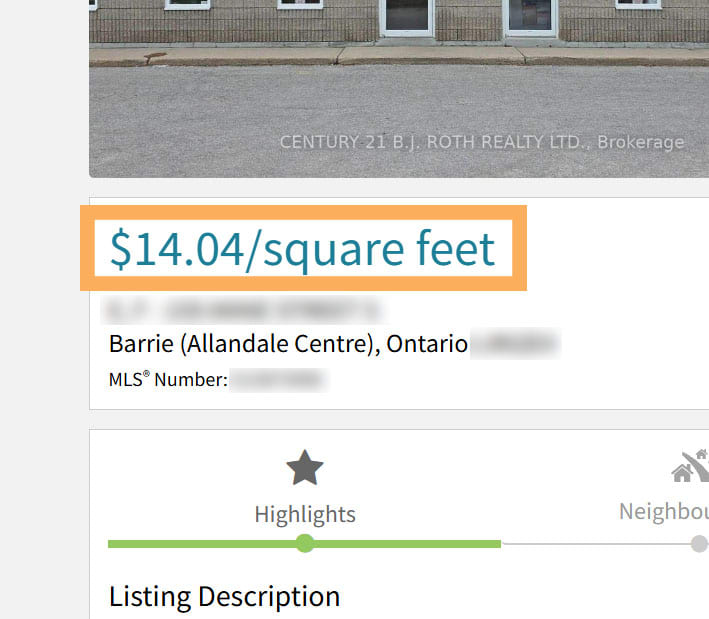
Understanding how commercial leases are structured can help you compare properties more accurately, budget for your business and avoid unexpected expenses.Commercial base rent can be listed as price per square foot
Base rent and additional rent
First, let's understand two common components of commercial rent:
Base rent is the amount charged for occupying the space. It is commonly listed as an annual dollar amount per square foot ($XX/sq ft/yr).
Additional rent refers to other amounts the tenant is required to pay under the lease (i.e. on TOP of the base rent). These may include property taxes, building insurance, maintenance, property management fees and other operating expenses.
What are the different types of commercial leases?
Gross lease
Under a gross lease, most building operating expenses are included in the rent. The landlord collects rent and uses a portion of it to cover expenses such as property taxes, building insurance and maintenance.
This can make budgeting more predictable for tenants. However, certain expenses, such as electricity, internet or the tenant's own business insurance, may still be payable separately (like in a residential lease).
Gross leases can often be found in office buildings and smaller commercial spaces.
Modified gross lease
A modified gross lease falls somewhere between a gross lease and a net lease.
The landlord and tenant agree on how specific expenses will be divided. For example, the landlord may cover property taxes, building insurance and exterior maintenance, while the tenant pays for utilities and maintenance within their own unit.
Some modified gross leases also require tenants to contribute toward increases in operating expenses above an agreed starting amount.
Single net lease (N)
Under a typical single net lease, the tenant pays base rent plus another major property expense (usually property taxes) or an allocated share of those taxes.
The landlord generally covers building insurance and other building operating expenses, subject to the terms of the agreement.
Double net lease (NN)
A double net lease typically requires the tenant to pay base rent, property taxes and building insurance, or their allocated share of those expenses.
Other building operating expenses generally remain the landlord's responsibility, depending on the agreement.
Triple net lease (NNN)
A triple net lease is a common structure in commercial retail and industrial real estate.
In addition to base rent, the tenant generally contributes toward three major categories of property expenses:
Property taxes
Building insurance
Maintenance and operating expenses
Tenants may also be responsible for utilities, repairs within their premises and other expenses specified in the lease.
A triple net lease can appear less expensive when looking at the advertised base rent, but the additional expenses must be considered when determining the actual cost of occupying the property.
Commercial lease types at a glance (typically)
The following table illustrates how common property expenses are typically allocated under different lease structures.
Lease type | Property taxes | Building insurance | Common area maintenance |
|---|---|---|---|
Gross | Included | Included | Included |
Modified gross | Varies | Varies | Varies |
Single net (N) | Additional | Included | Included |
Double net (NN) | Additional | Additional | Included |
Triple net (NNN) | Additional | Additional | Additional |
These are general descriptions rather than guaranteed arrangements. Always review the specific terms of the lease to determine which expenses you will be responsible for.
What is TMI in commercial real estate?
TMI stands for Taxes, Maintenance and Insurance. You'll often see this (or MIT) in Ontario commercial real estate listings.
Depending on the property and lease agreement, TMI (which is in addition to base rent) may include:
Municipal property taxes
Building insurance
Snow removal and landscaping
Parking lot maintenance
Common area cleaning
Exterior lighting
Common area utilities
Property management and administration fees
Certain building repairs
In a multi-tenant commercial property, these expenses are often divided among tenants based on the proportion of the building they occupy or another allocation method specified in the lease.
For example, a tenant occupying 2,000 square feet of a 10,000-square-foot commercial building may be responsible for 20% of certain shared operating expenses.
TMI does not necessarily cover every expense associated with occupying a commercial property.
How to calculate monthly commercial rent
Let's say you're considering leasing a 2,400-square-foot industrial unit with the following advertised rates:
Base rent: $15.00 per square foot
TMI: $6.00 per square foot
Assuming both rates are quoted annually, your estimated rent would be calculated as follows:
Expense | Annual | Monthly |
|---|---|---|
Base rent | $36,000 | $3,000 |
TMI | $14,400 | $1,200 |
Subtotal | $50,400 | $4,200 |
HST (13%) | $6,552 | $546 |
Total | $56,952 | $4,746 |
Your estimated monthly payment to the landlord would be $4,746, including HST, assuming the lease is taxable.
This does not account for separately payable utilities, business insurance or other expenses outside the quoted rent and TMI.
The general formula is:
Monthly rent before HST = (Annual base rent rate + annual TMI rate) × rentable square footage ÷ 12
Can TMI increase during your lease?
Yes. Unlike base rent, which is consistent (your lease will often have a predetermined schedule of increases), TMI is frequently based on estimated operating expenses that can change from year to year.
Many commercial leases provide for an annual reconciliation, where the landlord compares the estimated expenses collected from tenants against the actual expenses incurred.
Using the previous example, suppose the actual TMI for the year ends up being $6.60 per square foot instead of the estimated $6.00 that the landlord originally thought it would be.
The difference of $0.60 per square foot across a 2,400-square-foot unit would amount to an additional $1,440 before applicable HST for that year.
Depending on the lease agreement, the tenant may be required to pay the difference. Conversely, an overpayment (i.e. the real TMI ended up being less than anticipated) may result in a credit or refund to the tenant.
This is why reviewing previous operating expenses and understanding how additional rent is calculated can be valuable before committing to a property.
Is a gross lease cheaper than a triple net lease?
Not necessarily.
Consider two hypothetical commercial units of identical size:
Property A | Property B | |
|---|---|---|
Square footage | 2,400 | 2,400 |
Lease type | Triple net | Gross |
Advertised rent per sq. ft. | $15.00 | $20.00 |
Additional TMI per sq. ft. | $6.00 | Included |
Monthly rent before HST | $4,200 | $4,000 |
Although Property A initially appears less expensive, Property B has a lower combined rent in this example.
However, differences in utilities, maintenance obligations, building condition and other lease provisions could change which property offers better overall value.
Questions to ask before signing a commercial lease
When evaluating a commercial property, consider asking:
What expenses are included in the advertised rent?
Is the additional rent fixed or estimated?
What were the actual operating expenses in previous years?
How is my share of the building's expenses calculated?
Are utilities separately metered?
Who is responsible for repairing and replacing heating and cooling equipment?
Who pays for major repairs, such as roof replacement?
Can capital expenditures be passed on to tenants?
Are there limits on increases to certain operating expenses?
Can I review the calculations and supporting records for additional rent?
How will base rent increase throughout the lease term?
Ontario does not have a standardized commercial lease agreement. The specific wording of your agreement matters considerably more than whether the lease is advertised as gross, net or triple net.
Having a commercial real estate lawyer review the agreement before signing can help you understand your obligations and potential financial exposure.
Looking for commercial space in Barrie or Simcoe County?
Finding the right commercial property involves more than comparing advertised rental rates. Understanding the total cost of occupying a space, its suitability for your business and the obligations associated with the lease are equally important.
If you're exploring commercial properties in Barrie or the surrounding area, feel free to get in touch to discuss your requirements.
This article is intended for general informational purposes and does not constitute legal, financial or tax advice. Rental rates used in the examples are illustrative and do not represent current market rates.